Asset valuation
The asset valuation module manages the valuations the council needs for its accounts, following the CIPFA Code of Practice on Local Authority Accounting and the RICS Valuation – Global Standards (the Red Book) with its UK national supplement. It is an optional module: an administrator switches it on in Module settings. Find it under Buildings, Asset valuation.
Finance's criteria
Finance sets the rules, under Manage data:
| Setting | What it is |
|---|---|
| Asset classes | Each class's measurement basis, how often it is revalued, any index used in the years between, and whether buildings are depreciated |
| Year end | Normally 31 March |
| De minimis | Assets worth less than this are left out of the programme |
| Componentisation | Buildings worth more than the threshold are valued in significant components (by default, any worth 20% or more of the building value) |
| Valuer rotation | How long an external firm or lead valuer is used before rotating |
PHAEMA starts with the classes in the CIPFA Code, as defaults for finance to confirm:
| Class | Basis | Revalued |
|---|---|---|
| Other land and buildings (operational) | Existing use value; depreciated replacement cost for specialised buildings | Every 5 years |
| Investment property | Fair value | Every year |
| Surplus assets | Fair value | Every 5 years |
| Assets held for sale | Lower of carrying amount and fair value less costs to sell | Every year |
| Heritage assets | As finance decides | Not revalued by default |
| Community assets, assets under construction | Historic cost | Not revalued |
Classifying assets
Each top-level property needs an asset class. The first time, Classify them from their holding purpose classifies every property from its holding purpose in the register. Change a class on the property's valuation page with Reclassify, giving the date and reason (for example a Cabinet decision to dispose). The history is kept.
The yearly programme
The asset valuation page lists the assets due at the year end, and why: not valued yet, due on the class's cycle, or reclassified since the last valuation. Download the valuer's data pack (Excel), with each asset's address, UPRN, class, basis, tenure, floor areas, leases and rents, and last value, to send with the instructions.
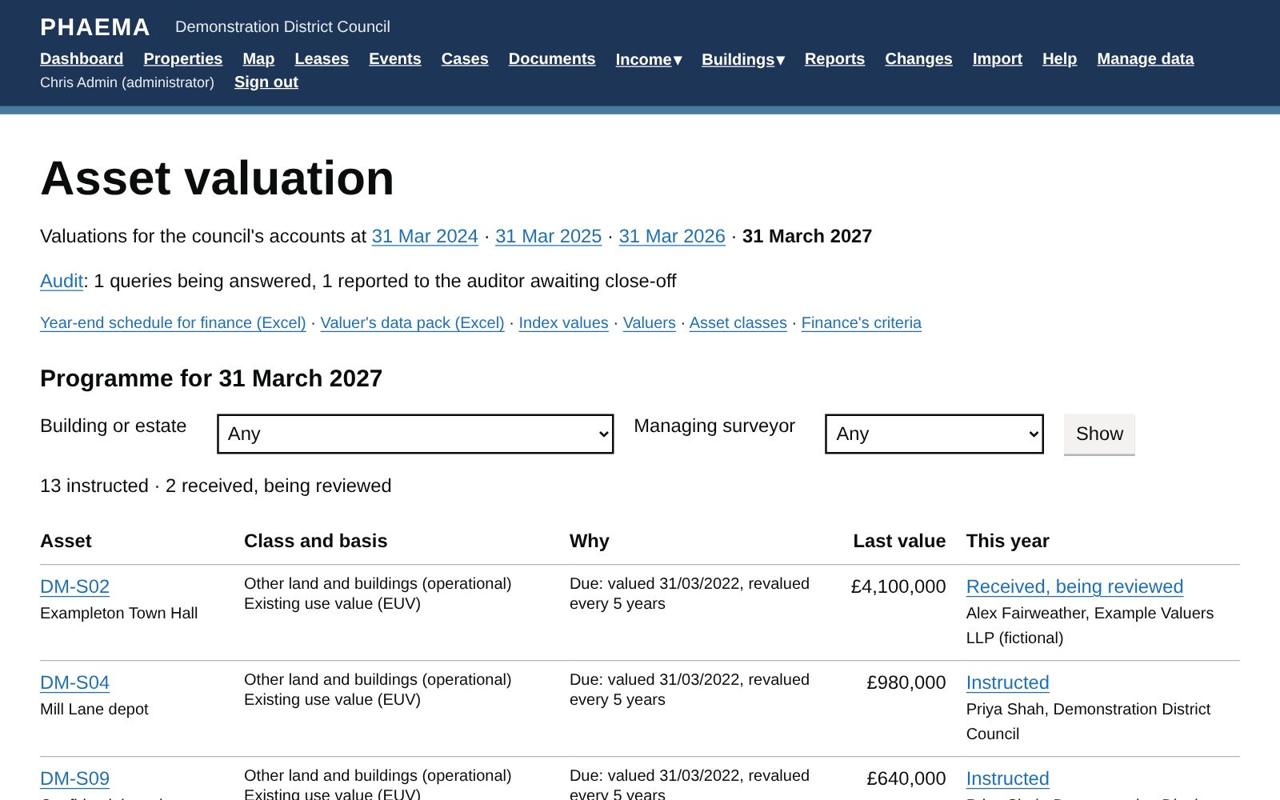 This year's programme.
Start the programme (administrators) opens a programme case, and an asset valuation case for each asset, owned by its managing surveyor, with an instruction recorded against it. The cases carry the task lists and the supervisor approval described in cases.
Assigning valuations
Every valuation is assigned to either a member of council staff or an external valuer:
- When starting the programme, choose who to assign every valuation to, or assign each one later.
- On a valuation's page, Assign or Reassign it: the list shows council staff (administrators and surveyors) and the external valuers set up under Valuers.
A member of staff is emailed, sees the valuation under Assigned to you on the asset valuation page and their dashboard, can record it, and takes over its case. For an external valuer, the case stays with the managing surveyor, who manages the instruction. The valuer's status (internal or external) is recorded with the valuation and shown in the year-end schedule, as the accounts must disclose it.
Recording a valuation
Values come back on each valuation's page, or all at once with the Valuer's returned figures import (see importing). PHAEMA records what the Red Book expects a valuation to document:
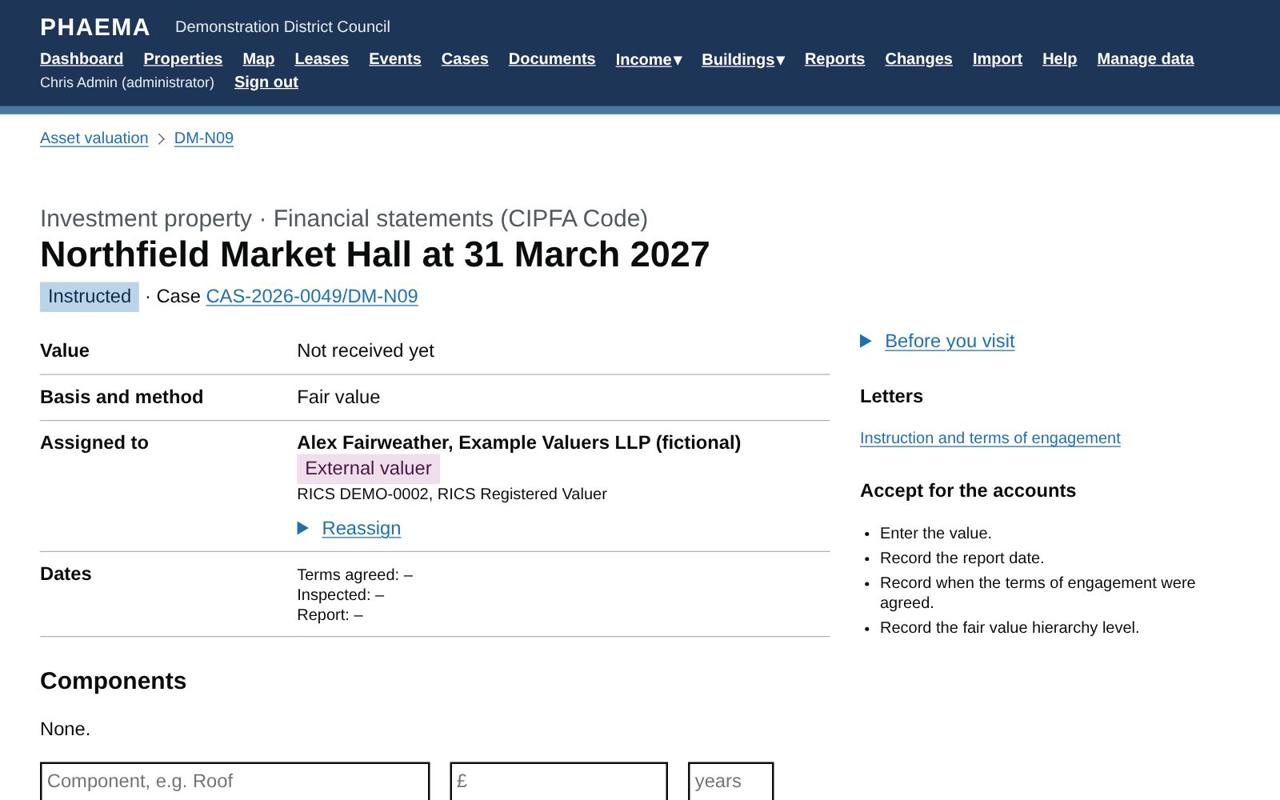 A valuation assigned to an external valuer.
- the basis, method and purpose;
- when the terms of engagement were agreed;
- the valuation date and the report date, separately;
- the inspection date and its extent: full, external only or desktop;
- special assumptions and key assumptions;
- any material valuation uncertainty, with the valuer's statement;
- the valuer, whether internal or external, their RICS number, and any conflicts of interest declared;
- for fair value, the fair value hierarchy level (1, 2 or 3) the accounts must disclose;
- the value, split between land and buildings, the remaining life of the buildings, and significant components;
- the report itself.
PHAEMA checks that land and buildings add up to the value, and shows the change since the last valuation.
Accepting for the accounts
An administrator (normally finance) selects Accept once the valuation is complete. PHAEMA will not accept a valuation without a value, valuer, report date and terms of engagement, or a building over the componentisation threshold without its components. Accepted valuations are locked; an administrator can reopen one.
Audit
Valuations can be flagged for the external auditor, answered and closed off:
- Flag for audit (administrators), on the valuation's page: why (selected in the auditor's sample, an auditor's query, flagged by finance, or an internal review), the auditor, their query, and when the response is due. By default the response is prepared by the valuer (if council staff) or the managing surveyor, who is emailed and sees it on their dashboard.
- Record the response sent to the auditor, with any evidence, and the date it was reported. The status becomes Reported to the auditor.
- Close (administrators) when the auditor is satisfied, with the outcome: no change, valuation amended, accounts adjusted, or other. If the valuation is to be amended, closing reopens it so it can be changed and accepted again.
Each step is also noted on the valuation's case. The Audit page lists every flagged valuation for each year's accounts by status, and downloads the audit log for the auditor as Excel.
Impairment and material change
PHAEMA prompts a review when something happens after a valuation that may affect value: a change of occupation or holding purpose, a lease ending, an emergency repair, or a component graded D. Open a review starts an impairment review case with the reasons in its notes.
The year-end schedule
Year-end schedule for finance downloads every classified asset with its class, basis, valuer, valuation date, value, land and buildings split, remaining life, material uncertainty and components, for the fixed asset register and the working papers. It also gives the fair value level and the indexed value.
Indexation between valuations
Between full valuations, the CIPFA Code expects the council to check that carrying amounts are not materially different from current value. Each asset class can name an index, for example the BCIS All-in Tender Price Index for operational buildings. Administrators record index values under Index values on the Asset valuation page. PHAEMA then brings the last accepted value forward to the year end: the index is applied to the buildings only when land and buildings are split, and to the whole value otherwise. The indexed value and the factor appear on the property's valuation page and in the schedule. It is a guide for deciding whether a revaluation is needed, not a valuation.
Worked example
In this year's programme, the water tower telecoms site (DM-N07) and Hilltop Farm (DM-N10) are assigned to Lena Chen as a council staff valuer, so they appear under Assigned to you for her; the rest go to the external valuer. Last year's valuation of Northfield Market Hall was flagged for audit: the auditor asked about the turnover rent assumption and the yield. Rob Baker, the managing surveyor, prepares the response; when it has been sent he records it as reported, and finance closes it off once the auditor is satisfied.